


Project Copal | Research That Challenges the Disposable Pad Status Quo

INTRODUCTION
The dichotomous nature of menstrual health is stark: while period poverty and limited access to menstrual products remain persistent problems, the menstrual products industry thrives as a multi-billion dollar global market. The most common products in the market today- plastic disposable pads have been innovated over several years and promised women a life of convenience, they come with hidden costs that must be examined more carefully.
Globally, few corporations pushed for disposable pads to be the mainstream. They were marketed as the ‘solution’ for hygienic menstrual management (Sharma et al., 2022) and a step towards ‘modernity’. The key focus is that disposable pads have to be regularly stocked up, locking a dependent customer pool for these corporations. This has trapped us in a tradeoff of perceived hygiene against health risks, environmental impacts and financial costs. (Rapp & Kilpatrick, 2020).
Firstly, disposable pads contain various chemicals like dyes and fragrances, which can lead to skin irritation or allergic reactions in certain users. Notably, some of these chemicals, such as styrene, are carcinogenic, while others like chloromethane are reproductive toxicants (Park et al., 2019). Additionally, chloroform poses risks as a neurotoxin, and acetone is a significant irritant to the skin. The synthetic materials often trap heat and moisture, creating an environment conducive to discomfort and potential infections (Park et al., 2019).
Secondly, estimates find that a single disposable pad can take up to 500 to 800 years to decompose fully, exacerbating waste management challenges in the country. Improper disposal of these pads leads to environmental pollution, soil degradation, and contamination of water sources, posing health risks to communities (Peberdy et al., 2019). Lastly, many girls cannot afford commercially available pads or persuade their parents and other family members to prioritise their purchase. This lack of access to affordable menstrual products can hinder educational and professional opportunities for girls and women, impacting their overall well-being and socio-economic advancement (Banerji, 2018).
While these problems may seem to be prevalent in rural areas, the urban rich are not immune to the lack of awareness about the side effects of plastic pads and the alternative menstrual hygiene management practices.
This report is produced as part of Project Copal by Nepathya Foundation which aims to provide access to safe, hygienic and easy accessible pads. A survey was designed to understand factors that might lead to unfavourable perceptions around reusable cloth pads which are more economical, safe and sustainable. In this report, we discuss the results of the survey and document the experience of our users and identify avenues of improving the design of the cloth.
THE CLOTH PAD
After extensive research, we at Nepathya Foundation have developed high-quality cloth napkins made from flannel cotton which is irritation-free, safe to use and sustainable. The cloth pads follow the technical specifications laid out in UNICEF’s product description of reusable cloth pads. Additionally, the pads have also been reviewed and improved by the suggestions of eminent gynaecologists such as Dr. Meenakshi Bharath, a fertility expert with 15 years of experience and Dr. Sabine Kapasi, a women’s health specialist who has worked with UN, WHO, Lilavati, Fortis and DY Patil, to make it more suitable for the South Asian socio-political landscape. Lastly, the design has evolved over time to incorporate feedback from our users .
To ensure maximum protection, these napkins feature a double-layer cloth padding, minimising the risk of leakage. Additionally, the pads are equipped with buttoned wings for added stability. What sets these pads apart is their chemical-free composition, making them sustainable and 100% eco-friendly. Based on previous findings, these pads boast a lifespan of up to two years, providing a long-term and reliable solution for menstrual hygiene.


Additionally, reusable pad stands out for its economic benefits, offering a cost-effective solution compared to disposable options. On average, a girl uses eight disposable pads in a month (192 pads for two years). As of 2018, the average price of a large pad in the market was between 8- 10 rupees6 leading to a cumulative expenditure of Rs.1800 rupees approx. solely on sanitary napkin supply for two years. Reusable menstrual pads, constructed from cloth, provide a sustainable alternative to single-use products. By opting for these pads, individuals not only prioritise their own comfort and well-being but also contribute to reducing waste and minimising their environmental footprint (Anaba et al., 2022).
Cloth pads, being reusable, align with sustainable practices by reducing the amount of waste generated compared to single-use plastic pads. The latter, predominantly made of non- biodegradable plastic materials, contributes significantly to environmental pollution, persisting in landfills and oceans for hundreds of years after disposal (Anaba et al., 2022). This stark contrast underscores the importance of considering the environmental implications of menstrual hygiene choices.
Furthermore, the production and distribution models of these two types of pads vary significantly. Encouraging local production of cloth pads not only supports local economies but also fosters community development and empowerment. On the contrary, plastic pads are typically mass- produced in factories, often by large corporations, with a centralized production model that may not directly benefit local communities. Thus, the choice between cloth and plastic pads can also be seen as a decision between supporting local artisans and contributing to corporate manufacturing processes.
Chemical exposure is another critical factor to consider. Cloth pads offer a chemical-free and skin- friendly alternative, eliminating the risk of exposure to potentially harmful substances commonly found in plastic pads, such as dioxins and bleaching agents (Upson et al., 2022). This aspect of cloth pads contributes to overall menstrual health and comfort. In contrast, the synthetic materials and chemical additives in plastic pads may cause skin irritation and pose long-term health risks, particularly with prolonged use.
Additionally, absorbency and comfort play a significant role in the user experience. Cloth pads, with their natural fibers, often provide better absorbency and comfort compared to plastic pads. The breathability of cloth pads allows for better moisture absorption and airflow, reducing the likelihood of discomfort and odor (Upson et al., 2022). Conversely, plastic pads, while designed for absorbency, may have limitations in managing heavy flow effectively and can cause discomfort due to their non-breathable nature.
LITERATURE REVIEW
The study conducted by Ramsay et al. (2023) explored the use and perceptions of reusable period products among young individuals aged 15-29 in Victoria, Australia. Utilizing a combination of quantitative and open-text qualitative data from an annual cross-sectional survey, the research aimed to shed light on menstrual product preferences, priorities, and factors influencing the adoption of reusable materials. The findings revealed that 37% of participants had utilized a reusable product during their last menstrual period, with period underwear being the most commonly used (24%), followed by menstrual cups (17%), and reusable pads (5%). Additionally, 11% had experimented with reusable products in the past (Ramsay, 2023). Notably, the adoption of reusable products was associated with older age, Australian nativity, and higher discretionary income among participants. Comfort, protection against leakage, and environmental sustainability emerged as the primary considerations for menstrual product selection, followed by cost.
For reusable menstrual pads specifically, the rising popularity, as mentioned by Ramsay et al. (2023) is driven by their numerous benefits, beyond sustainability. According to Trade to Aid (2020), made from soft, natural materials like cotton fleece, they offer comfort and are free from the chemicals found in disposable pads, reducing irritation and potential health risks. Economically, reusable pads prove cost-effective over time, alleviating financial burdens, particularly for those facing period poverty. Their discreet design and noiseless materials provide comfort and privacy during changes, especially in public settings. Contrary to misconceptions, reusable pads are hygienic, requiring proper cleaning but offering cleanliness comparable to disposable options (Trade to Aid, 2020). Safety is
enhanced as they are typically made from organic, natural materials, free from harmful chemicals. Importantly, the environmental impact of reusable pads is significant, reducing landfill waste and the carbon footprint associated with disposable products.
Hennegan et al. (2016) conducted a cross-sectional evaluation of reusable sanitary pads among schoolgirls in rural Uganda. Their study found that girls using reusable pads reported significantly higher perceptions of reliability across various activities compared to those using existing improvised methods. The participants using reusable pads were also less likely to experience leaking, with perceptions of reliability ranging from 68% to 90%. This suggests that reusable pads offer a more reliable solution for managing menstrual flow, thus addressing concerns related to leakage and soiling (Hennegan, 2016).
Building on the findings of Hennegan et al. (2016), van Eijk et al. (2021) conducted a systematic review and meta-analysis of reusable menstrual pads for public health internationally. Their review included 44 studies with approximately 14,800 participants, predominantly in LMCs and refugee settings. Despite the overall low quality of the studies, the review found that cloth pad uptake varied widely, ranging from 22% to 100%. Notably, a Ugandan trial among school girls reported lower rates of leakage with cloth pads compared to cloths (Eijik et al., 2021). Additionally, self-reported skin irritation was significantly lower among reusable pad users compared to disposable pad users, indicating the potential health benefits of using reusable options.
Further supporting the feasibility and affordability of reusable menstrual pads, Chakwana and Nkiwane (2014) presented a study on the development of a low-cost reusable microfiber sanitary pad. Their research demonstrated that microfiber pads are easy to make using locally available materials, making them accessible to rural women. With a total cost of $2.40 per pad and an expected lifespan of at least two years, reusable microfiber pads offer a cost-effective alternative to disposable options. The economic advantage lies in the reusability of the pads, making them a sustainable and affordable choice for women in resource-constrained settings.
Collectively, these studies underscore the potential of reusable menstrual pads to address the challenges associated with menstrual hygiene management. By offering a reliable, cost-effective, and sustainable alternative to disposable products, reusable pads contribute to improving menstrual health outcomes and promoting dignity and empowerment among women and girls.
METHODOLOGY AND DATA
The study was designed and the survey was conducted by the volunteers of Nepathya Foundation, in collaboration with Maina Devi Foundation. Our primary sample is 78 female students of 9th Grade from a government school in Kathmandu, Nepal. We find that younger populations are easier to approach and more accepting of conversations around menstruation and trying alternative products. To supplement this sample, we also surveyed 17 additional users from a varied sample who chose to use the cloth pads for one month and document their experience.
For the sample drawn, we first conducted menstrual hygiene and awareness workshops. These workshops uncovered the taboo around menstruation and the risks of plastic sanitary napkins, delved into important aspects of female health, hygiene, and sustainability, and also explained the use and care of cloth pads.


Then, demographic data was collected including personal details such as name, age, height, weight, type of bleeding, blood flow, and contact information. These factors can influence the type of periods an individual experiences and we wanted to ensure that we do not have a biased sample. Age impacts hormonal changes during puberty and menopause, while height and weight affect body mass index (BMI), potentially impacting flow intensity. Different types of bleeding, from spotting to heavy flow, can vary among individuals due to hormonal imbalances or health conditions. Our demographic variables including age, height, and weight show that the data is quite normally distributed with the sample mean age being 17 years and sample mean height being 153.5 cm. Many girls did not report figures for their weight but for those that did report it, the average weight of the sample was 43.63 kgs.


Finally, two varieties of cloth pads were randomly distributed among the 95 participants - one dyed in a dark color and the other left in its natural light hue. Both varieties of cloth pads were made from flannel cloth and were no different from each other except for their colours. This allowed us to investigate whether participants' perceptions varied based on the colour of the pad they received. During the pad distributions, there were an equal number of dark- coloured and light-coloured pads that were distributed to the population.
Participants were actively encouraged to use the cloth pad and after a month offer comprehensive feedback regarding their experiences with the distributed cloth pads. The feedback survey was meticulously designed to encompass diverse aspects, including comfort, absorbency, cost- effectiveness, and overall user satisfaction with the cloth pads. Participation in this survey was entirely voluntary. Out of the 95 individuals that received cloth pads, 39 opted to use them and provided feedback. These surveys were conducted on a one-on-one basis and ensured anonymity to avoid any bias and influence on individual answers.
RESULTS
During the pad distributions, there were an equal number of dark- coloured and light-coloured pads that were distributed to the population. However, we notice that our final survey included a higher proportion of light-coloured pad users. While not certain, this can be indicative that most girls that received light-coloured pads felt more comfortable with using this product since it is easier to spot bleeding and therefore avoid leakages on a lighter cloth. We have also come across this narrative by other consumers who preferred lighter coloured pads as they emulated the market disposable pads.

The purpose behind conducting the intervention workshops prior to surveying the participants was to ensure that all participants used the cloth pads in the most efficient manner. In our study, 59% of the respondents used the cloth pads for an average of 5 – 6 hours in a day. Only over 7% of the respondents used the cloth pad for 7 hours. The participants were also able to follow the care instructions that were provided to them during the workshop.

Many attribute the ease of handling plastic pads by simply disposing of them as an advantage over cloth pads. Moreover, cloth pads need to be cleaned and maintained properly to increase their life and absorbency, which can be difficult for beginners (Iyer, 2014). However, our survey results indicated that only 5 out of 39 participants failed to follow few of these care instructions. An important factor behind this could be the unique design of our cloth pads which helps open it into a napkin (as shown above in figure 1). This helps fight stigma, as 90% of the respondents stated that they did not feel any discomfort in washing and drying the cloth pads in the sun.
Provided that the users followed the instructions shared with them on using cloth pads, our survey indicated very positive feedback on the experience of using cloth pads to manage menstrual cycles amongst our sample.

The survey results depict the pivotal factors driving individuals' decisions to opt for cloth sanitary pads. There is a growing awareness amongst users about health impacts of sanitary napkins. This could be a result of our workshops which broke down the composition of plastic pads and their harmful effects on human health. We, therefore, see health considerations as the biggest factor, with 75% of users reporting it is the main reason for choosing cloth pads as alternatives. 56.4% of the users highlighted cost-effectiveness which proves that they recognize the long-term economic benefit of cloth pads over disposable ones.

Our cloth pads can be used for a period of two years and factoring its life, 80% of the users find these pads to be in the range of affordable and very affordable. On the other hand, one would need a pack of 5 cloth pads for two years, leading to a cost of only Rs.250.
While cloth pads offer savings in the long run, the initial investment might still be perceived as somewhat substantial for some individuals. This can be seen in the results as 20% of the respondents did not find it cost beneficial to purchase cloth pads. Additionally, this may stem from factors such as differing economic circumstances or preferences for more immediate cost-saving measures.
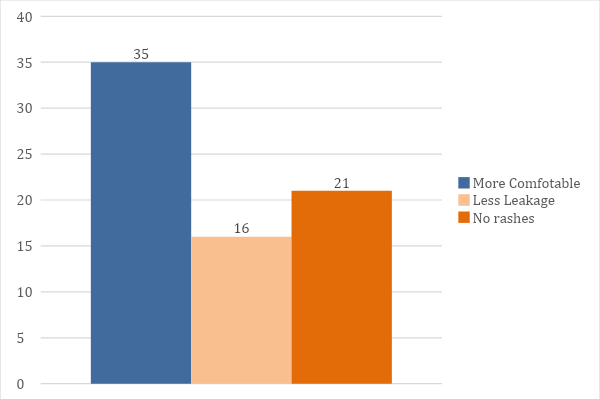
The transition from disposable sanitary napkins to cloth alternatives yielded overwhelmingly positive results among participants, with a notable improvement in comfort, reduction in vaginal rashes, and a positive environmental impact. 89.7% of the users reported indicated that they found the cloth pads more comfortable which enhanced their overall menstrual experience. Large number of users also experienced lesser leakages and no rashes around their private parts when compared to disposable pads.

The survey results depict a high level of satisfaction among respondents regarding the overall performance of cloth sanitary pads. No respondents rated their satisfaction as a 1 or 2, signalling a notable absence of extreme dissatisfaction among participants.
LIMITATIONS
Despite all measures taken to ensure a robust survey, there are certain limitations which may have led to biases in our results.
Firstly, it is important to acknowledge that our sample was positively influenced by the awareness workshops we conducted prior to distributing the cloth pads and surveying the participants. While this was important to ensure proper use of the cloth pads, participants were directly exposed to information which may have clouded their judgements.
Secondly, a larger proportion of our sample consisted of a younger population who are more likely to engage in such conversations and experiments. This indicates that the positive experience of using cloth pads might not resonate as closely with older women.
Thirdly, while all survey responses were collected individually to avoid any discomfort and promise anonymity, few participants seemed uncomfortable reporting explicit incidents from their experience. This could have also led to an under reporting of negative instances such as leakages.
Lastly, the survey was conducted after one month which allowed participants limited time with the product. Perceptions and experience of a product may change over a period of time, however, we are only able to capture the initial performance of the cloth pads.
CONCLUSION

This survey helped our team understand avenues of improvement in the design of the cloth pad. Though we mostly received positive feedback, some users reported few incidents of negative experiences. Less than 5% of the users also reported instances of leakage, itching and rashes. Some suggestions that the respondents reported included making the pads – softer, longer, thicker in size and having a stronger grip on the underwear. All these suggestions combined will help increase the pad’s absorbability, number of hours of wear and comfort experience.
In order to improve upon these factors, we have incorporated an additional layer of polyurethane (pu) coated fabric at the bottom which adds to the thickness of the pads and guarantees no leakages. It is important to note that this comes with a 10% increase in manufacturing costs which can only be managed in bulk productions.
Apart from this, a small percentage of users expressed still facing stigma while using cloth pads. This indicates a further need to destigmatize menstruation and the use of unconventional sanitary products within South Asian societies.
Overall, over the years many have become aware of the drawbacks of disposable pads not limited to economic, health and environmental factors and wish to switch to cloth pads in the long term. However, this switch must be accompanied with well-functioning products. In our survey, 37 out of the 39 respondents reported that they are either “likely” or “very likely” to continue using cloth pads after this study. This overwhelming inclination towards sustained usage suggests that most individuals who have experimented with cloth sanitary pads found them to be a compelling and satisfactory option for managing menstrual hygiene.
REFERENCES
Banerji, A. (2018). Third of girls in South Asia miss school during periods - study. New Delhi: Reuters.
Anaba, Emmanuel Anongeba, et al. “Use of Reusable Menstrual Management Materials and
Associated Factors among Women of Reproductive Age in Ghana: Analysis of the 2017/18
Multiple Indicator Cluster Survey.” BMC Women’s Health, vol. 22, no. 1, 26 Mar. 2022,
Chakwana, Christopher, and Londiwe Nkiwane. “Development of a Low Cost Re-Usable
Microfibre Sanitary Pad.” Textiles and Light Industrial Science and Technology, vol. 3, no. 0,
2014, p. 48, https://doi.org/10.14355/tlist.2014.03.008.
Hennegan, Julie, et al. “Schoolgirls’ Experience and Appraisal of Menstrual Absorbents in Rural Uganda: A Cross-Sectional Evaluation of Reusable Sanitary Pads.” Reproductive Health, vol. 13, no. 1, Dec. 2016, https://doi.org/10.1186/s12978-016-0260-7. Accessed 30 May 2019.
Iyer, H. (2014). Cloth Pads: Propagating Good Menstrual Traditions. Retrieved from Menstrupedia : https://menstrupedia.com/blog/cloth-pads-propagating-good-menstrual- traditions/
Park, Chan Jin, et al. “Sanitary Pads and Diapers Contain Higher Phthalate Contents than
Those in Common Commercial Plastic Products.” Reproductive Toxicology, vol. 84, Mar. 2019,pp. 114–121, https://doi.org/10.1016/j.reprotox.2019.01.005.
Peberdy, Elizabeth, et al. “A Study into Public Awareness of the Environmental Impact of
Menstrual Products and Product Choice.” Sustainability, vol. 11, no. 2, 17 Jan. 2019, p. 473,
Ramsay, Caitlin, et al. “Reusable Period Products: Use and Perceptions among Young People
in Victoria, Australia.” BMC Women’s Health, vol. 23, no. 1, 11 Mar. 2023,
Rapp, Ashley, and Sidonie Kilpatrick. “Changing the Cycle: Period Poverty as a Public Health
Crisis.” Sph.umich.edu, 4 Feb. 2020, sph.umich.edu/pursuit/2020posts/period-poverty.html.
Shalini. (2021, March 04). BUSTED! – 6 Common Myths About Cloth Pads. Retrieved from The Happy Turtle : https://www.thehappyturtle.in/busted-6-common-myths-about-cloth-pads/
Sharma, Aditi, et al. “Systematic Review of Menstrual Health and Hygiene in Nepal Employing a Social Ecological Model.” Reproductive Health, vol. 19, no. 1, 30 June 2022,


Comments